
The author, a tour manager with over 30 years of experience, argues that festival slots are often promoted as essential career milestones for emerging music artists but rarely deliver meaningful career advancement. Drawing on academic research and personal experience, he contends that any streaming or visibility boost from festival appearances is typically short-lived and tied to pre-existing momentum rather than caused by the performance itself.
The piece examines factors that diminish a festival slot’s actual reach, including stage placement, scheduling clashes, genre mismatches, and passive attendance, while noting that large crowd sizes don’t guarantee engagement. The author shares a personal anecdote about a band’s unsuccessful Lollapalooza experience to illustrate that substantial exposure does not necessarily translate into audience growth, concluding that festival appearances cost emerging artists significant time and money without guaranteed benefit.
I recently responded to a post on LinkedIn by Mike Carney from Live Nation Entertainment1. Mike’s posts about concert touring are thoughtful and insightful. Recently he posted about festival slots and their benefit to artists – a subject I have a view on – and I commented.
The character limit on LinkedIn comments stifled my explanation of why I think a festival slot is not the ‘holy grail’ for emerging acts, so I’m voicing my opinion here.
Festival appearances for emerging artists are not beneficial
I’m of the opinion that music festivals do emerging and ‘new’ music acts no favours. Performing at one in the early stages of an artist’s career is a waste of time and (a lot) of money.
The festival slot as ‘holy grail’
Getting on a festival bill is the ‘holy grail’ for many music artists and their managers. Performing at one of the major open-air, green-field events such as Glastonbury, Reading/Leeds, and Belladrum, is not just a career move. Those festival performances are like a rite of passage. The artist believes they are moving from being an unknown, ‘local’ act to being a recognised entity. Indeed, many artists I have worked with put up with the soul—destroying experience of performing at Glastonbury only because they went as punters back in the day. They swore to themselves that they would be on one of those stages one day, having ‘made it’.
Music artists emulating their heros
So, emulation is a consideration. Having attended music festivals when they were younger, they now wish to emulate their heroes by performing on those same stages. And the parents, who also attended festivals back in the day, will appreciate their children’s achievement of performing at Glastonbury or Isle of Wight – perhaps more so than other music business milestones.
Yet, despite the appeal to artists, I don’t think festival appearances are suitable for career advancement or hero emulation. The cons of a festival gig far outweigh the pros – unless your act already has significant momentum with streaming numbers in the hundreds of thousands and an engaged fanbase.
I encourage artists and managers to consider the cons (as in contra, Latin for against). But there is also the ‘con’, as in ‘confidence trick’ i.e. a scam.
The promise of exposure – and the reality
The main ‘con’ is the promise of exposure. This promise is used as a selling point to justify performance slots on small stages and ungodly hours. Artist managers may build a festival campaign into the ‘plot’ for an artist, citing the exposure those gigs will bring. Booking agents, touting for new business, may use the ‘we can get you on all the festivals’ as a way of sweetening the deal. Promoters will offer a low (or no) performance fee to an act for a festival slot, stating the potential exposure outweighs the immediate financial gain.
So it would be great if that promise of exposure was a guarantee, and the gig resulted in new and more fans of the artist. Unfortunately, there is no guarantee that this will happen, and a lot of this is gut feeling on behalf of promoters, festival organisers, and booking agents. I don’t think anybody can say that an emerging or unknown act will ALWAYS benefit from a festival slot. There is no data to say this will happen. Or is there?
Research shows little benefit – and it will be short-lived in any case
Researchers at Universitat de València in Spain studied 190 artists who performed at Primavera Sound and FIB festivals in Spain2. They found YouTube search activity jumped by 8 to nearly 11 per cent immediately after a set by an artist performing at one of those festivals. However, that’s just search activity, and does not mean engagement. Also, the sample set included headliners and well-known acts, as well as the emerging acts. Another paper by Danielsen and Kjus at the University of Oslo found streaming rose by roughly 40-43% around Norway’s Øya festival, but they couldn’t separate how much came from the performance itself and how much from festival promotion and playlisting before the artist performed3.
The strongest research in this area measures streams and searches for artists opening up for another artist on tour. Jeff Apruzzese of Drexel Univesity tracked 57 artists who opened for major touring acts (including those on the Eras tour by Taylor Swift), using Spotify listener data alongside Pollstar and Chartmetric figures4. Apruzzese found streaming rose during the tour and fell sharply once it ended. A separate write-up of the same data put the numbers at roughly an 18-20% increase during the tour and a 6-10% decline afterward – basically a return to pre-tour levels. And that’s for artists who, by the fact they were on such mass-appeal tours in the first place, probably had significant streaming numbers to start with.
The research suggests that if your artist’s streaming numbers are low, you may get a temporary and short-lived spike from the exposure, and then the numbers will drop back to where they were. And what’s the good in that?
A festival performance is one of many factors
I found a few other related studies, and none of them found conclusive evidence that a slot leads to a continued increase in streaming or ticket sales after a festival appearance. The research that exists on the career progression of music artists treats festival and support slots as one factor among several, alongside reputation, relationships, and existing momentum, rather than as an event on its own that results in further fan engagement.
Streams and searches drive festival bookings, not the other way around
And as mentioned, artists who land big support slots and festival bookings usually already have some momentum behind them: existing streams, management, a booking agent, and relationships with promoters and festival organisers. A rise in streams after the booking can be a continuation of a trend that helped them get the booking in the first place, rather than something the booking caused. We know that promoters and organisers look at streaming data and that it drives demand for live bookings, which is the reverse of the ‘festival performances create demand’ idea.
A large crowd does not mean a large or engaged audience
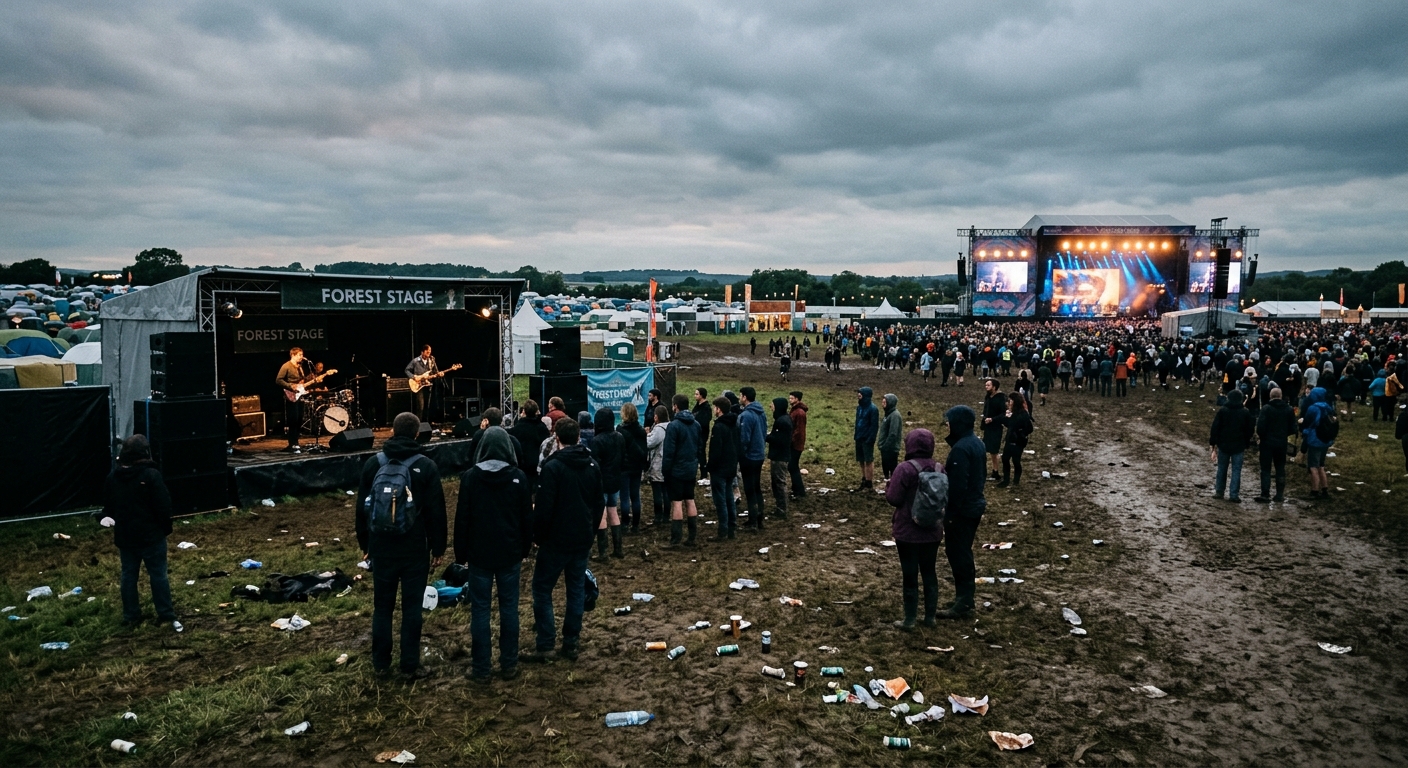
The capacity of the festival often validates the promise of exposure – ‘your’e going to perform in front of 30,000 people!’. But festival capacity is a poor metric to judge the number of people who will actually notice, remember, or follow up on an unknown act. Venue capacity, including individual marquees and arenas, doesn’t accurately represent the potential audience size on the day.
Consider these (fairly obvious) factors that degrade the reach of your act:
- Stage placement — a small or secondary stage at a 50,000+ capacity festival may draw only a few hundred attentive people.
- Clashes — a slot scheduled against a more well-known act on another stage will obviously impact attendance come your artist’s stage time.
- Genre mismatch — a crowd assembled for one genre will not meaningfully engage with an unrelated act, however large the festival’s overall audience.
- Passive attendance — many festival-goers will be trudging/wading between stages, waiting at food/bar areas, or recovering back in their tents. This number of people is a good chunk of the attendance, depending on the weather and the time of day.
- No guaranteed marketing inclusion — your act will not benefit from the festival’s brand-halo effect unless you or your booking agent are really pushy and/or have clout (your booking agent has several other, well-known, acts at the same festival, for instance
What I’ve seen in real life
My view on the lack of career advancement from a festival slot was always based on my experience. In fact, I have a stock anecdote I trot out when getting into a conversation about emerging artists getting a festival slot.
In 2007 I worked with a band that was touring a new project comprising ex-members of various other acts. These other bands had been successful in the 90s and had an existing, albeit small, fan base. (There is no point in me typing the name of the band, as you will never of heard of them, and that’s the point of my anecdote).
We did a run of dates supporting a well-known hard rock band at 50,000-capacity open-air venues, and then festival appearances at that year’s Lollapalooza. These were enormous crowds; the project band had a reasonable time slot and therefore the best exposure possible. It won’t surprise you to learn, given the tone of this article, that the ‘exposure’ did not pay off. There was no measurable engagement from music fans, and the project band stopped working shortly afterwards.
And this anecdote has always been my answer to the ‘ we need to get on festivals for exposure’ statement. Appearing in front of a huge festival audience was meant to ‘break a band’, but it certainly did not in this case.
Unfortunately, that’s the pattern I’ve seen repeatedly with artists low down a festival bill or contracted to a support slot: it doesn’t work for the artist, and it costs them time and money. Travel, crew wages, time off other paid work – it all mounts up. It’s difficult to own any part of the production or the exposure when you’re playing lower down a festival bill. You’re a guest on someone else’s stage, even on a multi-artist festival bill.
This is my opinion – and that’s all it is?
That’s the broad strokes of my opinion on why you shouldn’t pursue festival slots for your artists. I will type more on this soon, detailing more reasons not to pursue festival slots, and what alternatives there are if performing live is part of the strategy to break your artist. Thank you for reading!
Are you planning a tour?
- https://lnkd.in/p/e3Njwsic ↩︎
- Montoro-Pons, J.D., Caballer-Tarazona, M. and Cuadrado-García, M. (2023) ‘Assessing complementarities between live performances and YouTube video streaming’, Empirical Economics [Preprint]. Available at: https://doi.org/10.1007/s00181-023-02444-4. ↩︎
- Danielsen, A. and Kjus, Y. (2019) ‘The Mediated Festival: Live Music as Trigger of Streaming and Social Media Engagement’, Convergence: The International Journal of Research into New Media Technologies [Preprint]. Available at: https://doi.org/10.1177/1354856517721808. ↩︎
- Apruzzese, J. (2024) ‘Did You Catch the Opener? Exploring the Transformative Dynamics of Opening Performances: A Quantitative Analysis on Streaming for Emerging Artists’, Journal of the Music and Entertainment Industry Educators Association [Preprint]. Available at: https://doi.org/10.2478/meiea-2024-0001. ↩︎
