
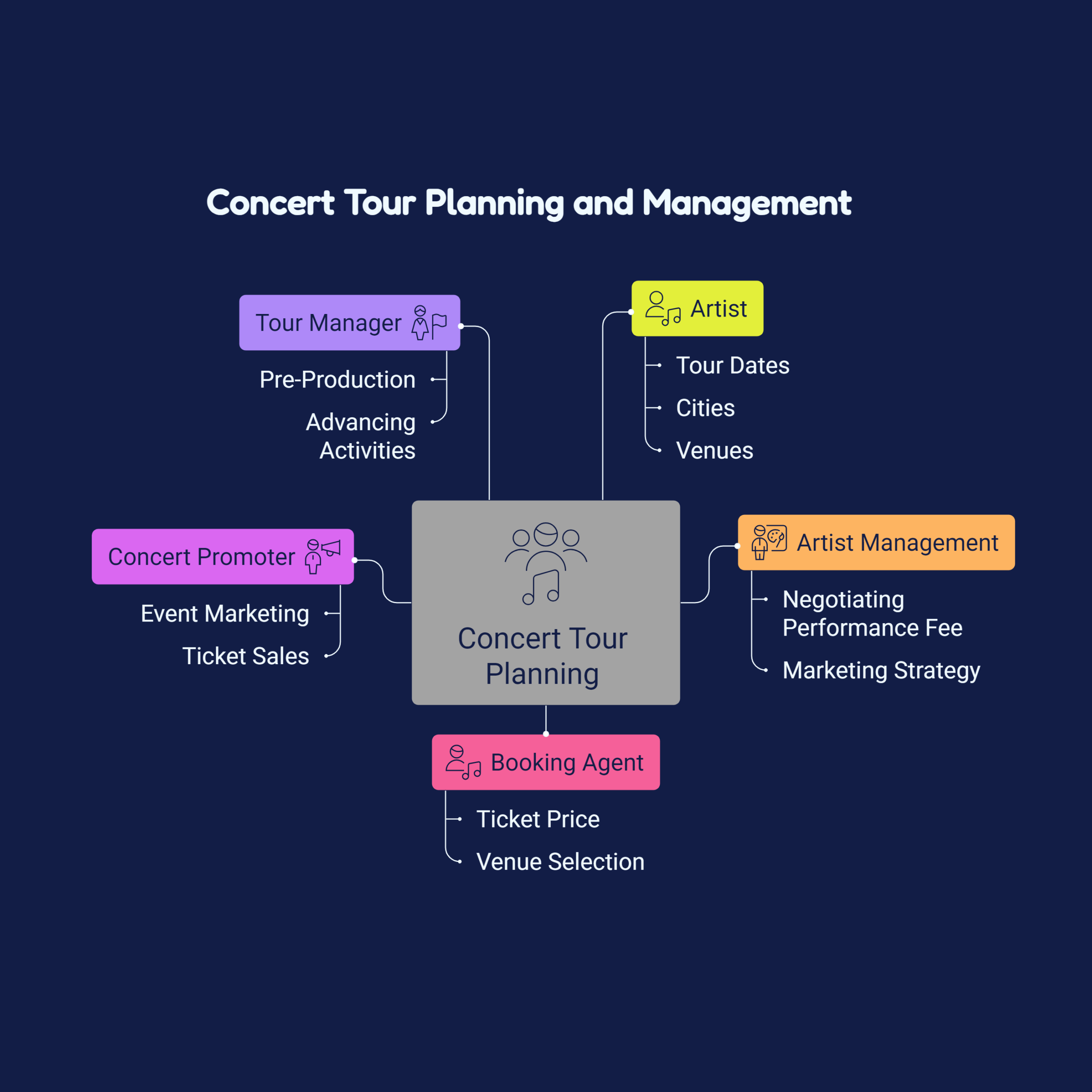
Planning a tour involves the artist, artist management, booking agent, and concert promoter working together to decide on tour dates, cities, and venues, ticket price, marketing strategy, as well as negotiating the performance fee itself.
Once all this is completed, the artist’s concert tour manager will start pre-production and advancing activities. Both are vital processes that directly affect the logistical and financial success of the tour.
This is an explanation of my pre-production and advancing process, with tips and explanations if you are doing it yourself.
- The Tour Budget Is Your Planning Roadmap
- Building the Contract Rider
- Production and Gear Planning
- Logistics: Transport and Hidden Costs
- Advancing
- Supplier Management
- Putting It All Together
Key Takeaways
- Pre-production and advancing are separate but connected jobs: pre-production is the budget and logistics, and advancing confirms every aspect with every promoter and venue.
- Your tour budget works as a checklist as much as a forecast, every line is a reminder to book or confirm something, not just a cost.
- The contract rider (catering, hospitality, input list, stage plot, backline) tells promoters exactly what they’re agreeing to before the concert. The rider should be available when the contract is being discussed.
- Trucking and transport quotes rarely reflect the real cost because they usually exclude carnets, driving permits, border fixers, catering for days off, and extra days for pickup/drop-off.
The Tour Budget Is Your Planning Roadmap
The budget isn’t only a profit and loss forecast. I use it as a checklist. Every line item on a well-built tour budget is a reminder to enquire about, plan for, or book something. I’m not just filling in numbers when working through my budget template, I’m using the act of filling them in to make sure nothing gets missed. Wages for a merch seller might not belong in the main touring budget in terms of cost, since merch income can’t be guaranteed, but that person still needs transport, food, and a bed like everyone else on the road, so the line stays in as a reminder.
But the main job of the budget is telling you, honestly, whether the tour is affordable. Income minus expenses gives you the profit, or the shortfall. If your artist is signed, and their contract with the record company allows, you can apply for tour support to cover the shortfall. You need to plan for the money though – expect tour support payments in two tranches, commonly 75% before the tour and 25% after, and expect to wait up to 90 days for either payment to arrive in your artist’s bank account. An artist manager applying for tour support at the last minute can find themselves owing suppliers money that hasn’t been invoiced yet, let alone paid.
The standard categories I use for every budget are:
- wages (including per diems)
- accommodation
- transport
- production (sound, lights, video, backline, set and stage)
- rehearsals
- other expenses – agent commission, withholding tax, and visas, etc.
If you’ve read my piece on creating a tour budget, this will already be familiar. Everything below feeds into these categories.
Building the Contract Rider
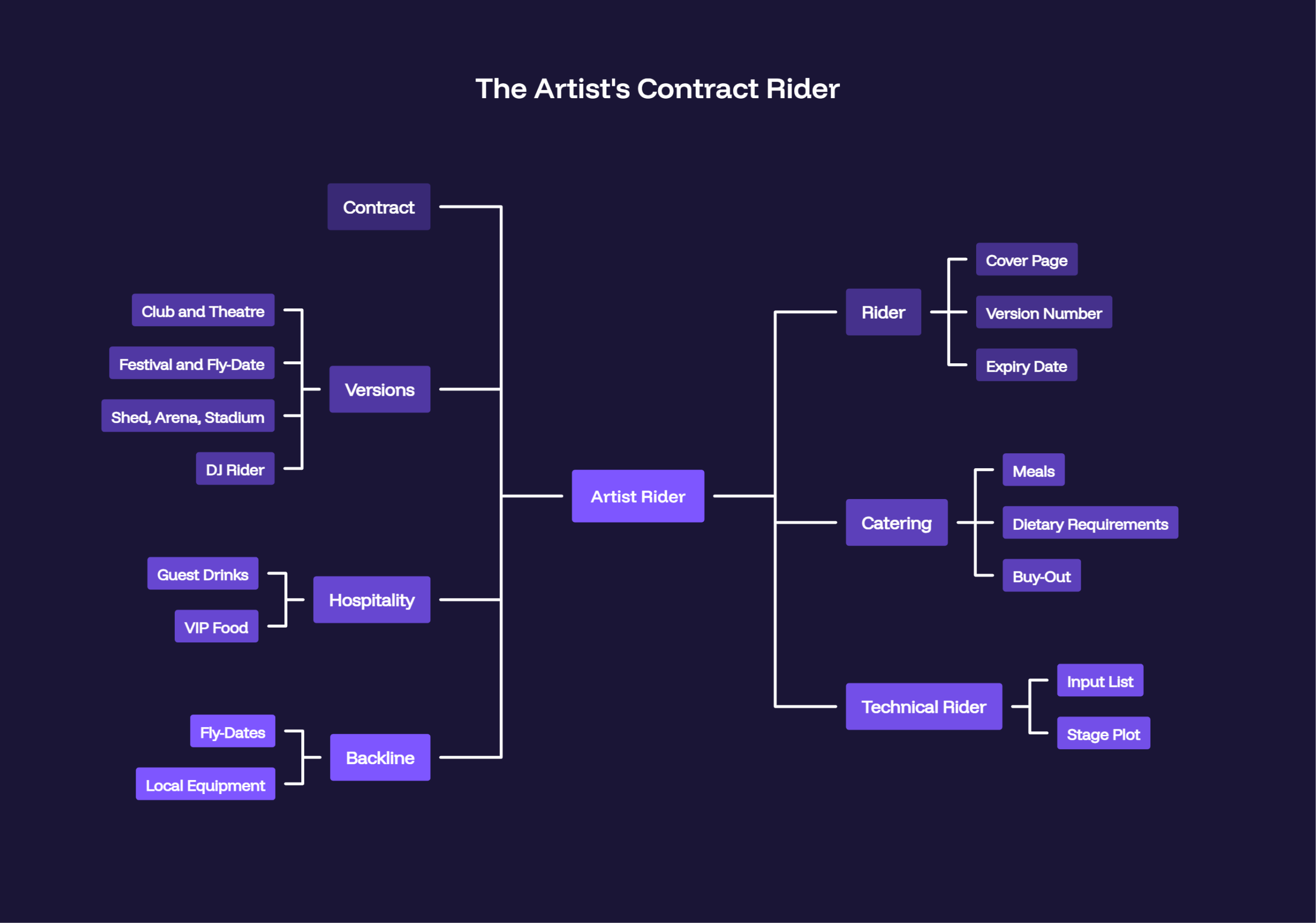
The contract sets out the terms for one specific concert. The rider rides alongside it, and it applies to every concert the artist performs. It’s written by the artist, usually with input from the tour manager and technical crew, and it tells the promoter exactly what they’re agreeing to supply.
Most artists will need more than one version. A club and theatre rider looks different from a festival and fly-date rider, which looks different again from a shed, arena, or stadium rider. DJs have their own rider format too. Whatever the type, the rider needs a cover page and, critically, a version number and an expiry date. Concert production generates a huge volume of documents that change without warning, and version control keeps everyone working from the same copy.
Catering and hospitality get their own sections, and they’re not the same thing. The catering rider covers food and drink for the touring party itself, meals, snacks, dietary requirements, and sometimes a buy-out instead of hot food at smaller venues. Hospitality covers guests and VIPs, the drinks and food set aside for people invited backstage after the show. Keeping these separate stops an artist accidentally listing enough beer for forty meet-and-greet guests on their standard performance rider.
At a basic level, the technical rider comprises two documents: the input list and the stage plot. Built by the artist’s front-of-house engineer from a rehearsal inventory, the input list tells the venue’s audio team precisely what is being sent through the PA, detailing each channel with its position (stage left or right) and any specific notes to eliminate guesswork for the in-house crew regarding terms like “bass boom” (for instance).
The stage plot is the diagram version of the same information, showing where everything and everyone is on the stage. An accurate stage plot becomes especially important at festivals where the artist’s gear is being built on rolling risers with minutes to spare between changeovers.
Backline, the instruments and equipment the artist actually plays, gets listed in the technical rider too, and it needs particular attention for fly-dates. Flying to a festival on another continent usually means leaving the heavy gear at home and asking the promoter to supply equivalent equipment locally, so the backline section of the rider needs to specify exactly what “equivalent” means.
None of this is paperwork for its own sake. Every section of the rider tells the promoter what they’re buying before they agree to buy it.
Production and Gear Planning
I use the term ‘Production’ for all the ‘steel and wood’ on tour. I split production into six categories:
- sound (or PA)
- lighting
- video
- backline
- set
- stage
Whether any of these costs the artist money depends on the venue. ‘Non-production’ venues, generally under 1000-capacity, come with sound and lights already installed. ‘Production’ (>1000-capacity) venues don’t, and everything needed for sound and lights gets rented in for the concert. The promoter pays for the rental, as part of their costs. However, artists elect to take their own ‘production’ (lighting floor packages, touring audio consoles, etc.) one) to differentiate themselves from other touring music acts and two), to maintain consistency of sound and visuals. The artist pays for these extras and so they go in the budget.
Backline has its own budget line that gets forgotten more often than it should: consumables. Drum sticks, guitar and bass strings, reeds, picks, batteries, tape. A guitarist changing a full set of strings on every date of a twenty-show tour will get through close to £300 in strings alone. It’s a small number on its own and an easy one to miss when you’re focused on the big production quotes.
Before any of these reaches a venue, your artist, and the crew needs a production rehearsal, ideally close to the first date on the tour and close to your suppliers. Production rehearsals are not about practicing the songs; bringing all six production elements together in one room before day one is where the programming of in-ear monitoring (IEM) mixes and specific lighting cues takes place. It’s also where you find the problems with weight, power, and fit while there’s still time to fix them.
Logistics: Transport and Hidden Costs
Music artists mostly use road transport to move between concert dates. Your artist will probably start their touring in a splitter van (seats for nine people including the driver) and have to move to sleeper buses (up to sixteen beds) if the number of passengers or the logistics change. You must budget for unforeseen costs, as well as the daily rate for the vehicle.
For instance, it can take a day to pick up a splitter, get to the artist’s lockup or rehearsal space, load up and be ready to get on-the-road. You should add that extra day of rental to the budget, plus an extra day’s wages for the tour manager or driver to undertake that activity. Likewise, at the end of the tour, getting to home base, dropping off the band, crew, equipment, and returning the vehicle may take you into an extra day’s hire and the associated costs.
At the other end of the touring scale, trucking quotes look straightforward – they itemise the truck, driver, fuel, and insurance. However, there are many extra costs and activities.
- ATA carnet costs are extra and calculated on the value of the goods being carried. A tour carrying half a million euros of equipment adds several hundred euros in carnet costs alone.
- Driving permits for weekend and holiday travel in parts of Europe are usually the local promoter’s responsibility to supply, and they need to be requested well ahead of the date.
- Border complications in some territories require a fixer or translator to keep customs clearance moving, and that cost isn’t in the trucking quote either.
- Carnet weights need to match what’s actually on the truck, because trucks get weighed at borders and a mismatch delays everything behind it. Whoever supplies the carnet may charge for weighing and measuring the equipment.
Advancing
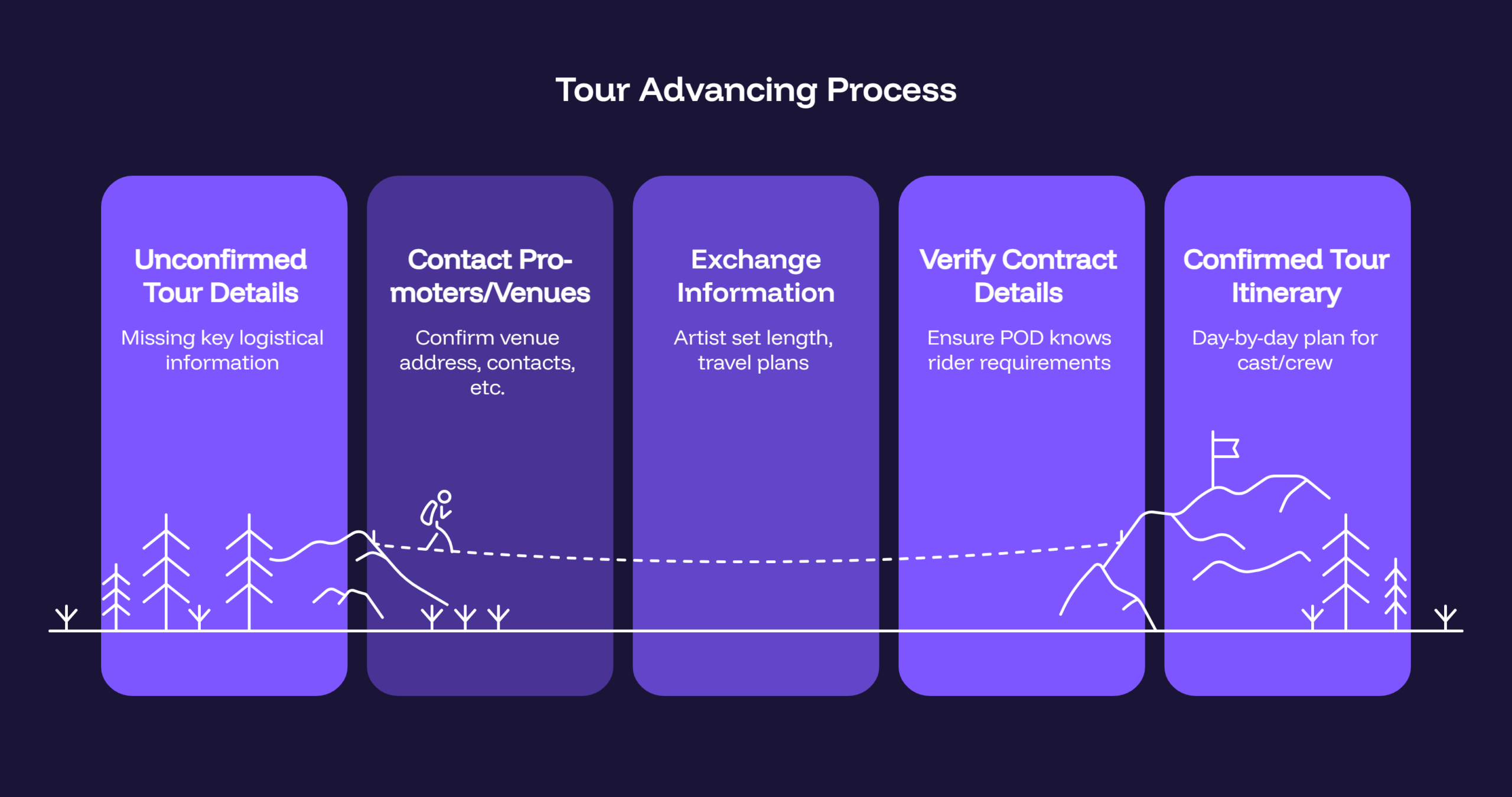
Advancing is the process of contacting every promoter and venue on the tour ahead of time to confirm the details. Advancing typically covers:
- the exact venue address
- contact details for the person on the day (POD)
- parking and power for tour vehicles
- load-in access
- soundcheck windows and any noise curfews
- showering facilities
- dressing room count
- catering and meal times
- merch concession fees
- wi-fi access codes
…among a long list of other questions.
Advancing is a conversation that goes both ways: the promoter wants to know the artist’s set length, whether the artist has a merch seller travelling with them, and where the artist is coming from and going to next, mostly so they can plan for a late arrival or pass on a lost item to the next venue on the route.
One thing worth knowing before you start advancing: the person who signed the contract is often not the person handling the show on the day. Information gets lost between the two, and advancing frequently means starting from scratch even on a deal that’s fully signed. Don’t assume the venue contact already knows what’s in the rider.
Everything gathered during advancing used to end up in a tour book, and now is entered into one of the many apps designed for this purpose. Master Tour, Daysheets, Road Ops etc display the day-by-day itinerary for the cast and crew, as well as the wider team – the record company, management staff, and vendors.
Supplier Management
Speaking of suppliers, the relationships extend into the money side too. Someone needs to make sure there’s enough cash available to pay suppliers before the tour earns a penny, since sleeper buses, rehearsal rooms, and crew transport all need paying for in advance. A float, whether cash or a credit card limit, covers the small stuff on the road, and a simple bookkeeping system, even a spreadsheet, keeps every expense tracked against what was budgeted. None of this needs to be complicated for a smaller tour, but it does need to exist.
Putting It All Together
Long before the first date of the tour, you want to be able to say yes to each of these:
- The budget is built and you know your shortfall, if there is one, and whether tour support has been applied for.
- The rider is finalised, versioned, and has gone out to every promoter on the tour.
- Production quotes are in hand and cover more than just the equipment: transport, techs, consumables, and power requirements.
- Transport is booked, insured properly, and you’ve checked the insurance gap against the value of what’s travelling.
- Advancing is well under way for every date, and someone has populated Master Tour.
You can read more about building the first piece in my guide to creating a budget for a concert tour, and about the person usually running this whole process in What Does a Concert Tour Manager Do?
You can also read my book, The Live Music Business – Management and Production of Concerts and Festivals, for more detail on all of the above.
