
Table of Contents
In short: The carnet is a ‘passport’ for your equipment. You get an ATA carnet stamped at customs every time the gear crosses a border: outbound at UK ports and airports, on arrival at the foreign customs point, and again on the way home. Each crossing uses the correct coloured voucher — yellow for UK export/re-import, white for foreign import/re-export, blue for transit — and a missing stamp at any stage breaks the chain customs needs to see.
This guide is for UK-based artist managers who are responsible for getting their artist’s equipment in and out of the UK. It assumes you already know broadly what an ATA carnet so I am not going over that here. Instead, I’m going into the ‘dark arts’ of knowing where and when to get it the carnet ‘stamped’ – the vital action of getting the gear exported and re-imported.
This is knowledge you can pass onto your artist and your concert tour manager (CTM) if they are unsure.
How the carnet document ‘works’
The ATA carnet is a set of vouchers with counterfoils.
The green front cover shows the holder’s details and the list of participating countries. [1]
Inside, you have sets of coloured pages:
- Yellow – UK Export and Re-import vouchers + counterfoils.
- White – foreign Import and Re-export vouchers + counterfoils. [1][2]
- Blue – Transit vouchers, used when you pass through a carnet country en route to another. [2]
- The General List – the inventory, or manifest, of gear – is printed on the back of the cover and on the vouchers. [1]
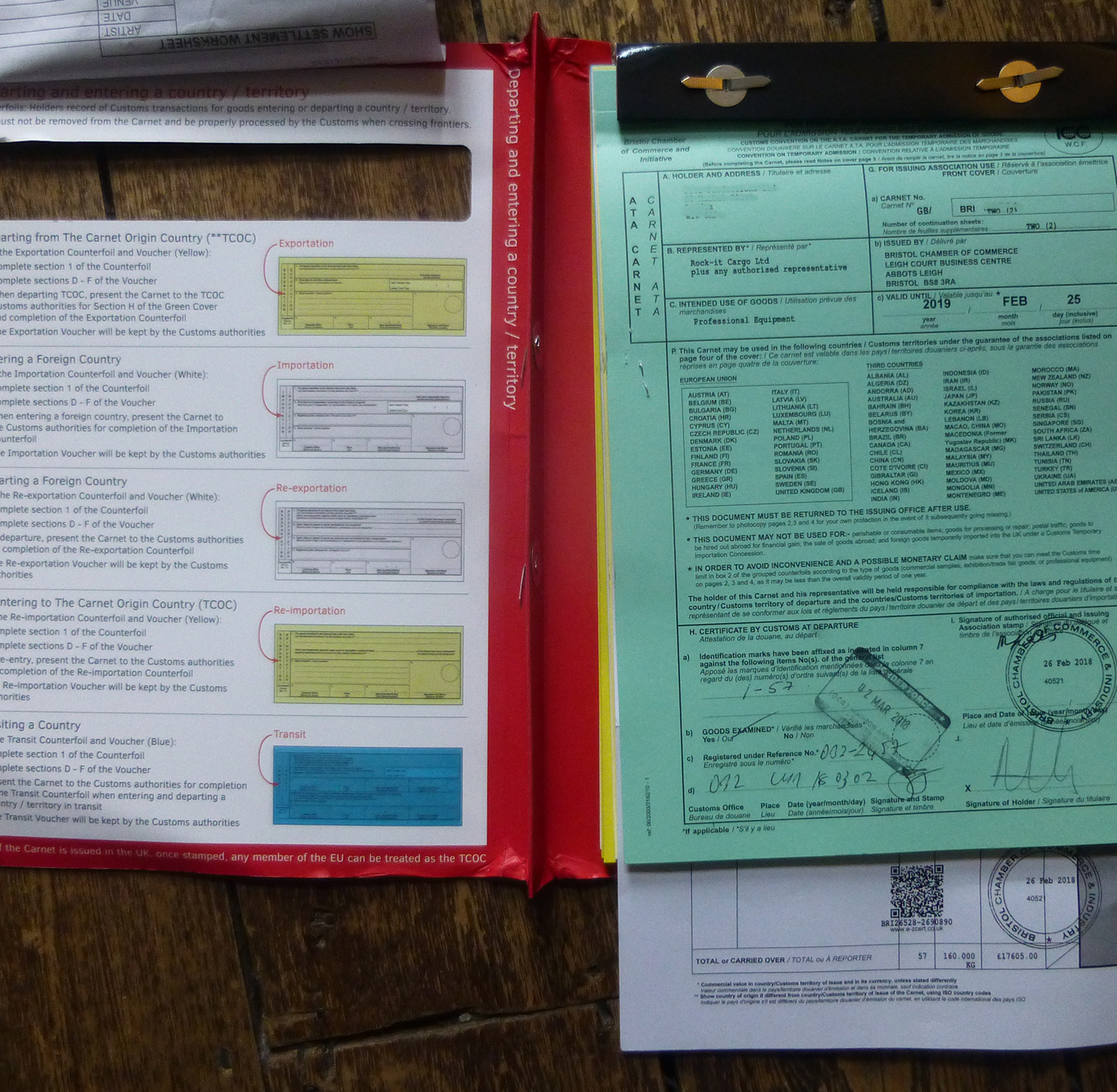
Once a voucher is used and removed by customs, it’s gone and you can’t reuse it. [2][6]
Your job (or your CTM’s) is to:
- Make sure there are enough vouchers for the route. [6]
- Use the correct colour and type at each crossing. [2]
Keep the carnet intact, legible and travelling with the gear. The carnet should not buried in a trailer, or given to someone who is not with the gear at all times.
You should think of the carnet as a bound sequence of “episodes” in your gear’s journey. Each episode – export, import, re-export, re-import – exchanges one voucher for one stamp. If an episode is missing, the story doesn’t make sense to customs.
PART A: The carnet and touring by road in splitter vans, sleeper buses with trailers, and trucks
Your artist, and their gear, will most likely be travelling by road. This is what you need to know when leaving the country.
Post-Brexit reality: UK vs EU
The UK is now a third country to the EU. Temporary movements of professional equipment from Great Britain into the EU are treated like any other export/import; an ATA carnet is the recognised way to handle temporary admission and re-import. [7][8]
The key points for you and your artist team:
- Someone must stamp the carnet each time you enter or leave the EU customs territory (including the UK side) to show that movement. [2]
- The EU is one customs territory. Once you’re in, you can normally move between EU member states without re-stamping, although Switzerland and Norway are separate. [9]
UK outbound – Dover, Eurotunnel, Holyhead, and other ports
For splitter vans, sleeper buses with trailers, and trucks, load the vehicle(s) in GB in line with the General List. Someone, usually a CTM, should oversee the packing of the van or trailer. Do not pack any items that are not on the carnet.
You then get the yellow Export voucher and counterfoil stamped before you leave Great Britain. [2] [3]. This is the dreaded ‘stamping’ we talk about in touring.
Finding the place to get your carnet stamped is difficult, and I have listed what I know below.
Dover and Eurotunnel (Folkestone)
HMRC now route most carnet traffic via Sevington Inland Border Facility (IBF) near Ashford for export and re-import checks linked to Dover and Eurotunnel. [3] [4] [7]
Practically, that means:
- You (or your entertainment transport company) book Sevington via the government system.
- After check-in, the driver must drive to Sevington.
- All drivers and carnet holders must wear hi-vis jackets or tabards.
- Border Force stamps the yellow Export voucher (which is removed) and the yellow Export counterfoil (which stays in the carnet). [3] [4]
However many CTMs (including me) recommend using the Motis facility at Dover Marina, especially if travelling by ferry. There is a £10 charge to park at the Motis offices, and anecdotes suggest the stamping process is quicker than at Sevington. There is also a café at the Motis facility – there are no such facilities yet at Sevington.
The Facebook group
The ‘UK Touring Crew‘ group on Facebook is invaluable in finding out about changes to stamping procedures. You are advised to request to join the group; once ‘admitted’, a simple search of ‘carnet stamping’ in the group will give you the up-to-date picture of conditions and wait times at Sevington and Dover Marina.
Holyhead – Ireland/EU via Dublin
Carnet traffic uses Holyhead IBF (Parc Cybi) for ATA stamping, both outbound and on return. [3][10]
Other GB ports (Portsmouth, Poole, Plymouth, Harwich, Hull, Liverpool, etc.)
These still handle ATA carnets via port-based customs offices rather than IBFs. [4][8]
Detail varies by port; the safe assumption is “freight customs office near the lorry check-in, not the tourist car lane”. A look on Google Maps the night will save a great deal of time on the embarkation day.
It is good practice to photograph the stamped counterfoil before leaving any official office. That way, you have some proof the gear left the UK under the carnet.
EU entry and exit – road, ferry, Eurotunnel
You must get the carnet stamped again when entering the EU at the ferry port or rail terminal.
EU IN (first entry into EU)
At Calais, Coquelles (Eurotunnel), Hook of Holland, Rotterdam and similar ports:
Follow signs for Customs / Douanes.
Present the carnet and vehicle.
The EU customs officer will:
- stamp and take the white Import voucher, and
- stamp the white Import counterfoil. [2]
Take a photo of all paperwork before you leave the office, just in case.
Once that’s done, you’re legally in the EU customs territory.
EU OUT (leaving the EU customs territory)
When you leave the EU back to GB (or into a non-EU state):
- Stop at EU customs at the last exit point (e.g. Calais, Rotterdam).
- Present the carnet for the white Re-export voucher + counterfoil stamping. [2]
Helpful customs or embarkation staff may wave you through before you can explain about the need to get your carnet stamped. If this happens you should:
- Park safely after the lanes.
- Walk to the customs office and insist on the Re-export stamp.
Without EU OUT, customs records may show the gear entered the EU but never left – which is exactly the scenario that triggers duty/VAT questions.
Switzerland and Norway by road
Both Switzerland and Norway sit outside the EU customs union and treat carnets very seriously.
Switzerland
At entry (e.g. Basel, Chiasso, Geneva), Swiss customs use the white Import voucher + counterfoil. [9][11]
At exit, they must stamp the white Re-export voucher + counterfoil.
Swiss border and customs agents keep regular office hours, and you may find the offices closed if you arrive during the night. You should plan not to cross these borders between 21:00 and 05.00am if you can help it.
Norway
You must treat Norway as a separate customs territory if entering from Sweden by road or into Norway by ferry.
You need white Import and later white Re-export stamping at Norwegian customs. [11]
Again, If you enter either country without proper stamping, you are effectively importing gear without declaration. This will cause immense problems when you try to re-enter the EU zone and again when going back into Britain. [2][11]
The carnet and touring with multiple vehicles
The tour may have one or more production trucks, or perhaps a truck and a sleeper with a trailer. All the equipment carried on all vehicles needs clearance for customs, so you must decide on:
- One carnet per vehicle or load (safest at the border), or
- One primary carnet. This will mean brutal discipline over which case is in which vehicle, and both vehicles always travelling and crossing at the same time.
From a risk perspective, separate carnets per primary vehicle is the safer option and more expensive.
When things go wrong with carnets on the road
Travelling with a bonded gear under a carnet is not easy. These are common things that happen in my experience:
- Customs office are closed on arrival. In this case you either divert to another open office or wait. Never cross without the stamp.
- You, or the customs officer, uses the wrong voucher or colour. You should ask for an immediate correction when this happens. Get some kind of written note and take photographs of the ‘soiled’ pages, plus the corrections.
- Missed EU-OUT or CH-OUT. This is common and you should expect to be told to go back to correct the sequence. This will obviously add hours to the artists’ journey, and they may miss sound check.
- Losing the carnet. Call the issuing chamber at once if you lose the carnet. Replacements are possible but slow; customs may treat the equipment as undeclared, resulting in fines. [6]
PART B: The carnet and flying with equipment
You will probably rent backline locally for fly-dates and foreign festival appearances. However, your artist may insist on flying with various hard-to-rent items. You will need a carnet for these pieces of equipment.
I recommend you don’t raise a manifest and carnet yourself through your local chamber of commerce, especially if flying to the USA. You should instead use a music-related freight forwarding company such as Rock-it, Freight Minds, or EFM.
Outbound from the UK
Whether you’re flying with racks and instruments as checked baggage, or pallets and cases as air cargo, you must get the yellow Export voucher + counterfoil stamped when the goods leave Great Britain. [2][3]
For accompanied baggage:
Stamping is usually at a Merchandise in Baggage (MIB) or customs desk in the passenger terminal.
For cargo:
The carnet is normally presented at the freight customs office by your forwarder (Rock-it, Freight Minds etc.). [12][13]
The carnet must physically travel with the gear or the person presenting the gear. Having the carnet in your hand luggage while the pallet flies the night before is a classic mistake! Your forwarder will advise you on all this.
Entry abroad – USA, Canada, Japan, Australia, EU airports
On landing:
Cargo – your freight agent presents the carnet at the cargo customs office.
Accompanied baggage – officials may route you through a red channel or secondary inspection. The foreign customs officer will:
- stamp and keep the white Import voucher, and
- stamp the white Import counterfoil with date and port. [2][5]
Exit abroad and UK return
Customs must complete the white Re-export voucher + counterfoil at the foreign airport or land border nearest the end of the tour.
When the goods re-enter GB, you must present the carnet for yellow Re-import voucher + counterfoil stamping (at passenger customs or a freight customs point/IBF, depending how the gear returns). [2][3]
If that inbound yellow stamp is missing, UK customs can treat the gear as imported without relief, with duties, VAT or even seizure.
When things go wrong with the carnet at airports
Things can go wrong with airfreight, even with a forwarder involved.
- The carnet and the gear get separated. The freight arrives, but the carnet doesn’t. Here, the gear will sit in a bonded storage racking up charges. You have used a forwarder, so it’s their job to track down the carnet. And to pay any resulting charges!
- Finding the relevant office. Where do you actually go to get ‘stamped’? For example, the Customs Border Protection (CBP) offices are in the arrivals hall of each terminal at airports in the USA. This is inconvenient when you are flying out of the airport!
- Multi-leg confusion. The gear arrives at one EU airport, but they never properly import it before onward travel. The carnet is now out-of-sequence. This can happen when flying the gear in the hold on festival-fly dates. The CTM must make sure there is plenty of time to get the paperwork done during the layover.
APPENDIX: 2025 UK CARNET STAMPING LOCATIONS
A quick look-up section of ports and other facilities.
A. Inland Border Facilities (road/ferry/rail)
Sevington IBF (Ashford, Kent)
- Main IBF for Dover ferries and Eurotunnel (Folkestone) although consider Motis at Dover
- Handles ATA carnet export and re-import checks for HGVs and smaller vehicles. [3][4][7]
Holyhead IBF (Parc Cybi, Anglesey)
- Handles ATA carnets for Holyhead–Dublin traffic, both outbound and inbound. [3][10]
Birmingham and Warrington IBFs are now closed; Stop 24 no longer processes ATA carnets – use Sevington instead. [4][7]B. Ports (non-IBF customs offices)
Still carnet-active via on-site customs offices on the freight side:
Portsmouth, Poole, Plymouth, Harwich, Hull, Liverpool, Immingham, Newcastle, and others listed in the LCCI “ATA Carnet Ports/Airports 2024” PDF. [4][8]
Rule of thumb:
Assume Sevington/Holyhead for Dover / Eurotunnel / Holyhead routes; assume port customs office (near freight check-in) for other ports, and always check current instructions before routing a show around a specific port.
C. Eurotunnel & Eurostar
Eurotunnel (Folkestone/Calais)
- UK side: via Sevington IBF.
- French side: Calais/Coquelles freight customs (Douanes). [4][7][8]
Eurostar (London St Pancras)
- Carnets can be processed but require advance notice to Border Force and extra time before departure. [8]
D. Airports (passenger baggage & cargo)
Heathrow (LHR)
- Merchandise in Baggage/customs points in terminals; if unmanned, use the phone to call Border Force.
- Terminal 5 has a Border Force desk behind check-in with a dedicated procedure for ATA carnets. [12][14]
Gatwick (LGW), Luton (LTN), Birmingham (BHX), Manchester (MAN), Glasgow (GLA), Edinburgh (EDI), London City (LCY)
All handle ATA carnets via customs/MIB desks or call-out, plus cargo customs for freight. [4][8][13]
REFERENCES
[1] Boomerang Carnets (n.d.) What does a carnet document look like? Available at: https://www.atacarnet.com/carnet-document (Accessed 28 November 2025).
[2] HM Revenue & Customs (2024) How to use your ATA carnet. GOV.UK, 17 April. Available at: https://www.gov.uk/guidance/how-to-use-your-ata-carnet (Accessed 28 November 2025).
[3] HM Revenue & Customs (2025) Attending an inland border facility. GOV.UK, 15 January. Available at: https://www.gov.uk/government/publications/attending-an-inland-border-facility (Accessed 28 November 2025).
[4] London Chamber of Commerce and Industry (2024) ATA Carnet Ports/Airports List 2024. LCCI. Available at: https://www.londonchamber.co.uk/LCCI_Media/LCCI/Media/Trade-Documentation/ATA-Carnets/ATA-Carnet-List-of-UK-Ports-Airports-2024.pdf (Accessed 28 November 2025).
[5] Cargo Clear (2024) Using ATA Carnet for luggage – Airport procedures & contacts. Available at: https://www.cargoclear.co.uk/ata-carnet-hub/using-ata-carnet-for-luggage (Accessed 28 November 2025).
[6] HM Revenue & Customs (2022) Apply for an ATA carnet. GOV.UK, 14 March. Available at: https://www.gov.uk/guidance/apply-for-an-ata-carnet (Accessed 28 November 2025).[7] ATA-Carnet.uk (2024) ATA Carnets at Port of Dover and Eurotunnel. Available at: https://www.ata-carnet.uk/information/port-of-dover-and-eurotunnel (Accessed 28 November 2025).
[8] Media Carnets (2024) UK & Europe Border Force Locations. Available at: https://www.mediacarnets.co.uk/uk–europe-border-force-locations.html (Accessed 28 November 2025).
[9] Paddles Up Training (2024) Carnets and Brexit: Carnets & implications since the UK left the EU. Available at: https://paddlesuptraining.com/wp-content/uploads/2025/01/01032023PUTBrexitAndCarnetV1-0DEC2024.pdf (Accessed 28 November 2025).
[10] Business West (2023) Important information for ATA Carnet drivers/hauliers. Available at: https://www.businesswest.co.uk/export/ata-carnet/important-info-drivers (Accessed 28 November 2025).
[11] HM Revenue & Customs (2025) Temporary admission: customs technical handbook – ATA carnets. GOV.UK, 4 August. Available at: https://www.gov.uk/guidance/temporary-admission-customs-technical-handbook/ata-carnets (Accessed 28 November 2025).
[12] ATA-Carnet.uk (2023) Using ATA carnets with hand luggage or baggage. Available at: https://www.ata-carnet.uk/information/goods-in-luggage (Accessed 28 November 2025).
[13] Cargo Clear (2024) ATA carnet hub – UK airport customs contacts. Available at: https://www.cargoclear.co.uk/ata-carnet-hub (Accessed 28 November 2025).
[14] Media Carnets (2023) UK Customs Border Force – London Heathrow Terminal 5. Available at: https://www.mediacarnets.co.uk/uk-customs-border-force-london-heathrow-terminal-5.html (Accessed 28 November 2025).